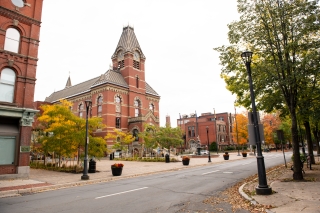
Standing proudly at the corner of Queen and York streets since 1876, Fredericton’s iconic City Hall has been at the very centre of community life for a century and a half. Officially opened in October 1876, this striking red-brick landmark is one of Fredericton’s most recognizable buildings and remains the oldest municipal hall still in continuous use in the Maritimes.
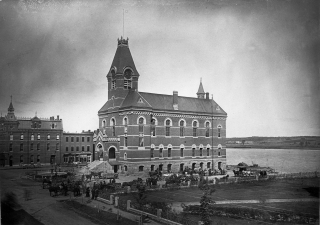
Designed by architects McKean and Fairweather and constructed by Crosby and Campbell, City Hall reflects a time when public buildings were meant to inspire confidence, pride, and a sense of permanence. Its Second Empire architectural style, defined by a high hipped roof, ornate detailing, and a commanding central clock tower, spoke to the optimism and ambition of a growing provincial capital.
From the very beginning, City Hall was much more than a place for meetings and paperwork. Like many 19th-century municipal buildings, it was designed to serve multiple civic roles. The first floor housed municipal offices and a Council Chamber, while the upper floor featured a large public auditorium known as the Opera House. The basement housed a magistrate’s office, jail and public market.
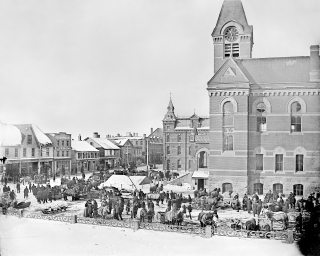
Although the building was designed with a clock tower, the clock itself came later. In the year following City Hall’s opening, research and fundraising for a clock began under the leadership of Mayor George Fenety. A fire bell was installed, followed soon after by the purchase of a clock. At 12 noon on May 1, 1878, the City Hall clock struck for the first time, beginning a long tradition of keeping Fredericton residents on time.
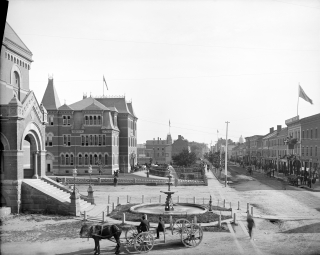
Mayor Fenety also played a key role in shaping the public space in front of City Hall. In October 1886, a fountain was installed in Phoenix Square. The original fountain featured three tiers topped by a small cherub statue formally known as Putto with Fish. After an editor at The Capital newspaper drew attention to his naked state, he earned the nickname “Freddy the Nude Dude.” As the years passed, the top two tiers of the fountain were removed after passersby complained about being caught in the spray.
As the city grew, so did the needs of its municipal government. In 1940, the Council Chamber moved upstairs into the former Opera House, and by the mid-20th century the market had relocated elsewhere. The Fredericton Police Force used the space until vacating the building in 1971. Even as its internal functions shifted, Fredericton City Hall remained a busy, working civic building, continually adapting while retaining its historic character.
For nearly a century, the exterior of City Hall remained largely unchanged. That began to shift in the 1970s. Following municipal amalgamation in 1973 and the demands of a growing city, the need to consolidate office space in one place became clear. In November 1974, after considering options that included tearing down the historic building to build a new civic building, City Council approved the construction of a new wing and renovations to the interior of the existing City Hall.
Designed by Graham Parkin Architects Engineers Planners, the brick-clad annex was intentionally modest in appearance, complementing the historic structure while nearly doubling the usable space. Construction began in September 1975 and was completed in 1977. Renovation work followed on the interior of the historic City Hall. An official reopening was held on July 1, 1978, with the building better prepared to serve a modern municipal government.
In recognition of its architectural beauty, historical significance, and enduring role in civic life, Fredericton City Hall was designated a National Historic Site of Canada in 1984 and later recognized under Canada’s Historic Places program in 2006.
That same period marked a new chapter in caring for the building’s most iconic features. After nearly 130 years of service, the City Hall clock was showing its age. In 2008, Balzer Family Clock Works of Freeport, Maine was awarded the contract to restore the original clock mechanism. The clock was carefully dismantled and transported to Maine, where it underwent a year of patient, meticulous restoration before returning home in June 2009.
As part of the project, the restored clockworks were relocated from the tower to a display location outside the Council Chamber on the second floor of City Hall, allowing visitors to see the intricate mechanism up close. The old fire bell found a new home on the third floor, preserving another piece of the building’s working past.
Care for the building continued in the years that followed. In 2011, City Council announced a multi-year masonry restoration program. The work included repointing brickwork and sandstone, reinforcing areas affected by stress fractures, and stabilizing the building’s foundation to ensure its long-term integrity. As part of this effort, the window and door trim was repainted in burgundy and tan tones. Research suggested these colours were closer to the heritage of the building.
Attention also turned to Phoenix Square. In 2012, City Hall restoration planning revealed that the historic fountain was experiencing accelerated deterioration. Council approved a full restoration, including a return to its original three-tier design. Robinson Iron of Alexander City, Alabama was awarded the contract, and in November 2012, Freddy and the fountain components were carefully removed and sent south for restoration.
On August 2, 2014, the fountain returned home to Phoenix Square, fully restored and once again complete. Modern wind-sensor technology was added to regulate water flow, helping protect passersby from the fountain’s spray, while preserving the fountain’s charm. Work was also done on Phoenix Square to modernize it as a welcoming public gathering place.
As Fredericton City Hall celebrates its 150th birthday in 2026, it stands as a powerful symbol of continuity, community, and civic pride – still doing the work it was built to do, still welcoming citizens through its doors, and still shaping the life of the city it calls home.